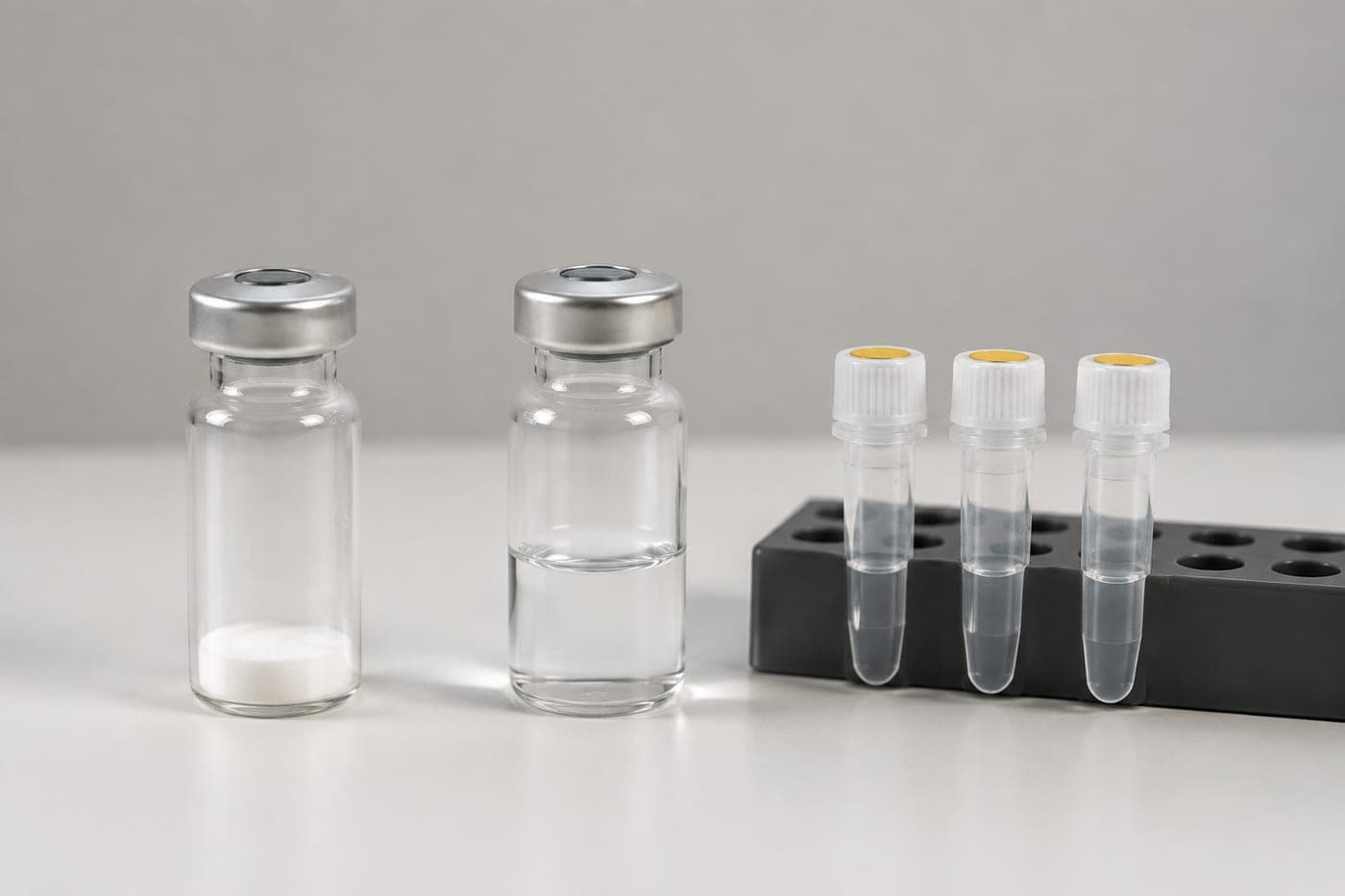
Dry material, a dissolved stock, and smaller aliquots. These are three distinct stages of preparation, and mixing them up is where most concentration errors come from.
Reconstituting a peptide means dissolving its freeze-dried material in a suitable liquid. The aim is a uniform solution with a known concentration that works in your experiment.
The essential sequence: confirm the peptide and solvent, calculate the final volume, add liquid in a controlled way, mix as directed, check dissolution, then label and store.
This guide covers preparation of peptide stocks for laboratory work. Start with the materials checklist, then use the worked examples and troubleshooting section when you need them.
Before You Add Any Liquid
Set out the materials and make the calculation first. It is much easier to catch a wrong unit or an unsuitable solvent before the vial is open.
Gather the essentials
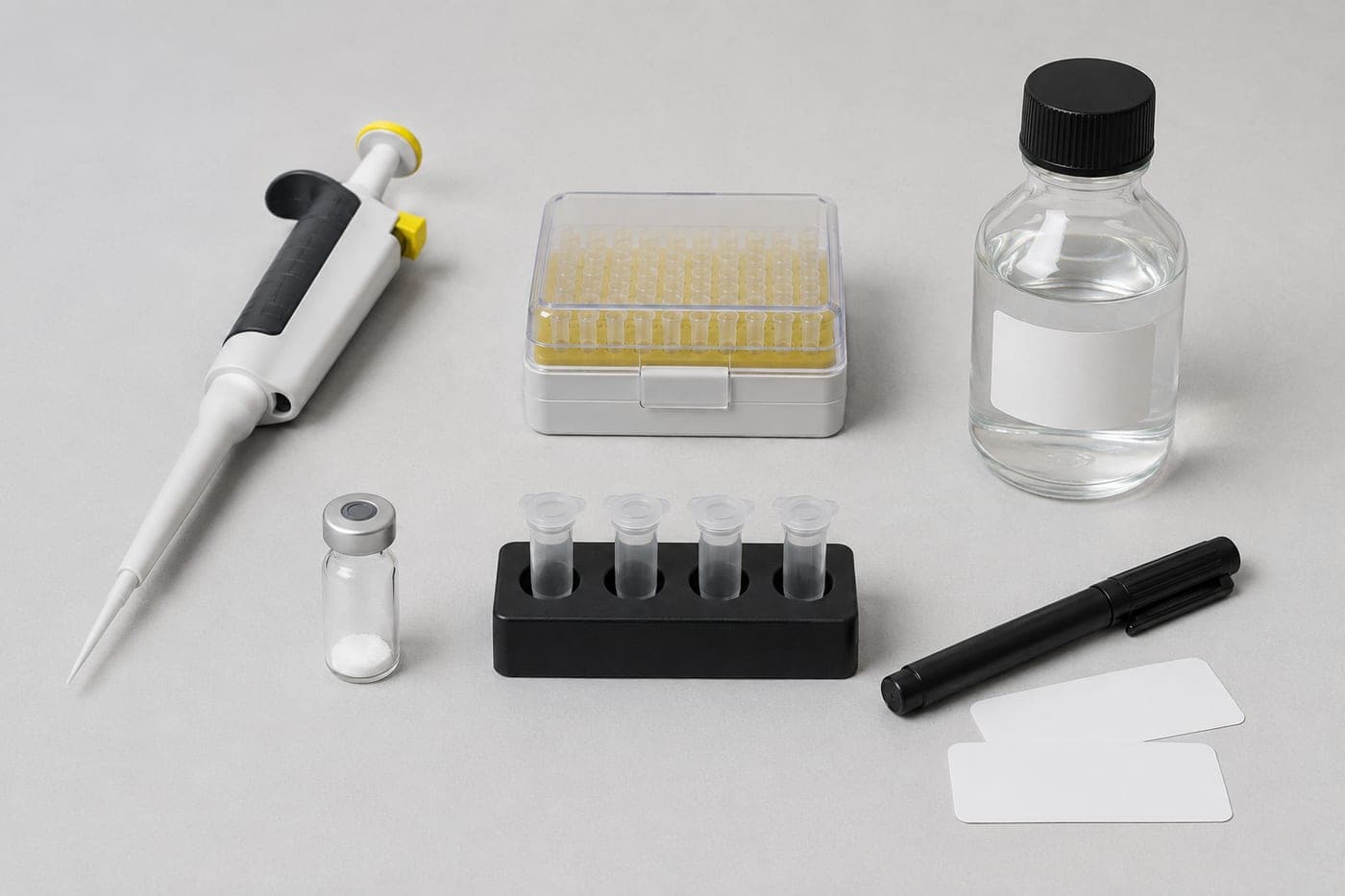
- Peptide vial and batch documents: identity, stated amount, solubility and storage information.
- Specified solvent: with the correct composition, grade and any required additives.
- Suitable transfer equipment: a calibrated pipette and compatible tips, or a sterile syringe and needle for a stoppered vial.
- Clean containers and labels: compatible tubes, a rack and a permanent marker. Add fresh alcohol swabs when accessing rubber stoppers.
Write down four things before you start: the peptide mass, the target concentration, the final solution volume and the solvent. Check that the vessel and measuring device can accommodate that volume.
Choose a Solvent That Fits the Peptide
Use the product or batch solubility information as your starting point. Peptide sequence, chemical modifications and solvent conditions affect dissolution. Water can work well, but no single liquid is suitable for every peptide.[1,2]
| Solvent option | Where it fits | What to check |
|---|---|---|
| Water of the required grade | A water-soluble peptide with a compatible protocol. | Grade, additives and the required experimental conditions. |
| Bacteriostatic water | A protocol that specifically accepts a preservative. | Benzyl alcohol content and compatibility with the peptide and assay. |
| Buffer or saline | A method requiring defined pH or salt content. | Solubility in that exact formulation. Saline is not a pH buffer. |
| Specified acidic or basic solvent | A sequence whose solubility improves at the validated pH. | Exact composition, exposure time and peptide stability. |
| Organic solvent or co-solvent | A hydrophobic peptide requiring a documented solvent system. | Stock solubility, downstream solvent percentage and chemical compatibility. |
Solvent selection and mixing principles: JPT.[1] Bacteriostatic water composition: Hospira product information.[3]
What the sequence can tell you
Basic peptides often benefit from acidic conditions; acidic peptides may benefit from basic conditions. Hydrophobic sequences may need an organic solvent before aqueous dilution. These are starting hypotheses for a small solubility trial, not guaranteed recipes. Modifications and oxidation-sensitive residues can change the choice.[1]
Bacteriostatic water is not a universal default
It contains a preservative, commonly benzyl alcohol, whose concentration should be read from the actual label. That preservative does not establish the stability of the peptide you add. Keep the solvent’s handling instructions separate from the peptide solution’s storage plan.[3]
Test before scaling up. When the solvent is uncertain, use a small, accurately measured sample or a supplier-prepared test aliquot. Check that it stays dissolved after dilution into the actual assay medium.
How to Reconstitute Peptides: Seven Steps
Use this sequence alongside the peptide-specific method. The solvent, volume, mixing conditions and storage plan should already be decided.
- Confirm the vial and calculation. Match the peptide name and batch number to the documents. Check what the stated mass represents, confirm the target concentration and calculate the final volume. Prepare the label before you start.[4]
- Prepare the vial and workspace. Clean the work area. For cold lyophilized material, let the tightly closed vial reach room temperature before opening unless its method specifies otherwise. This reduces moisture uptake from the air. Keep the vial closed until needed.[5]
- Prepare the access point and equipment. For a rubber stopper, use a fresh alcohol swab and let it dry. Use suitable sterile transfer equipment when the procedure requires it. With screw-cap containers, keep the cap interior and transfer surfaces from touching the bench.
- Measure and add the solvent. Use equipment suited to the volume and solvent. Add the specified liquid slowly and in a controlled way, along the inner wall if compatible with the method. If a stock solvent must be added first, follow that sequence and record every addition.
- Allow the material to dissolve. Start with gentle mixing if no other method is specified. Some peptides require time or a validated vortexing or bath-sonication step. Avoid improvising with heat, stronger solvents or prolonged agitation. A universal mixing time does not exist.[1]
- Check the solution and finish the volume. Compare its appearance with the documented expectation. Look for material on the wall or bottom. For a method defined by final volume, complete dissolution and then bring the solution to that volume using appropriate calibrated equipment. Mix uniformly.
- Label, aliquot and store. Record identity, batch, concentration, solvent, preparation date and storage conditions. Divide into practical aliquots when the method supports it. Use a storage period supported for that peptide and formulation.[6]
A useful final check: can another person reproduce the stock from your label and notes? If the mass basis, final volume or solvent is missing, the preparation record is incomplete.
Calculate Concentration Without Guessing
Reconstitution changes the form of the material. Dilution changes how much peptide is present in each unit of volume. The basic calculation is the same whether you prepare a small stock or a larger batch.
Concentration (mg/mL) = peptide mass (mg) ÷ final volume (mL)
Final volume (mL) = peptide mass (mg) ÷ target concentration (mg/mL)
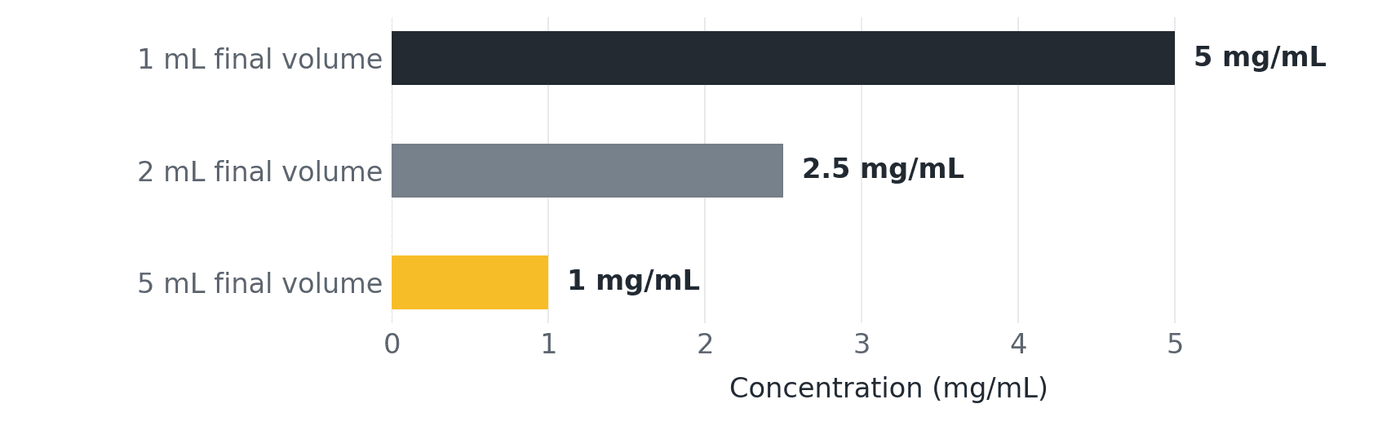
Example: 5 mg in a final volume of 2 mL gives 2.5 mg/mL. To prepare that same 5 mg at 1 mg/mL, the required final volume is 5 mL, provided the solvent, solubility and vessel capacity allow it.
| Peptide mass | Final volume | Concentration |
|---|---|---|
| 2 mg | 1 mL | 2 mg/mL |
| 5 mg | 1 mL | 5 mg/mL |
| 5 mg | 2 mL | 2.5 mg/mL |
| 10 mg | 2 mL | 5 mg/mL |
| 10 mg | 5 mL | 2 mg/mL |
| 15 mg | 3 mL | 5 mg/mL |
Arithmetic examples only. These values do not establish solubility or prescribe a preparation volume for a particular peptide.
“Add 2 mL” and “make up to 2 mL” are different instructions. Use final solution volume in the equation. If the documented method specifies an addition volume, follow it and use its stated resulting concentration. Do not estimate volume from liquid height in an uncalibrated vial.
Convert Units and Prepare a Working Dilution
| Quantity | Conversion | Example |
|---|---|---|
| Mass | 1 mg = 1,000 micrograms (mcg) | 0.5 mg = 500 mcg |
| Volume | 1 mL = 1,000 microlitres (µL) | 0.1 mL = 100 µL |
| Concentration | 1 mg/mL = 1 mcg/µL | 2.5 mg/mL = 2.5 mcg/µL |
How much peptide is in a measured sample?
Peptide mass in sample = concentration × sample volume
At 2.5 mg/mL, a 100 µL laboratory sample contains 2.5 mg/mL × 0.1 mL = 0.25 mg, or 250 mcg. Convert the volume to mL first, or use 2.5 mcg/µL × 100 µL. Both routes give the same answer.
How to dilute a stock
C₁ × V₁ = C₂ × V₂
C₁ is the stock concentration, V₁ is the stock volume to transfer, C₂ is the target concentration and V₂ is the final working volume. Keep the concentration units and volume units consistent.
Worked example: make 10 mL at 0.1 mg/mL from a 2.5 mg/mL stock. V₁ = (0.1 × 10) ÷ 2.5 = 0.4 mL, or 400 µL. Transfer that stock volume and make up to 10 mL total with compatible diluent. This takes approximately 9.6 mL of diluent, not another 10 mL.
Track the co-solvent too. If the stock contains 10% DMSO, a 1-in-100 dilution into DMSO-free medium gives 0.1% DMSO in the final mixture. The acceptable percentage depends on the assay. Use a matched vehicle control and verify compatibility rather than treating a generic percentage as universal.[1]
Check the arithmetic with Volta
Use the Volta Peptides Reconstitution Calculator to check the relationship between vial mass, liquid volume and concentration. Match mg, mcg and mL carefully, and record the values you used.[7]
Choose the solvent before using the calculator. A numerical result checks the arithmetic. It does not establish whether the peptide dissolves, remains stable or works in the chosen assay.
When the Peptide Will Not Dissolve
Start by checking the solvent, concentration and preparation record. Change one variable at a time on a small test sample so you can tell which adjustment helped.
| What you see | What to investigate | Next step |
|---|---|---|
| Powder remains | Time, concentration and solvent suitability. | Check the documented method; test a supported adjustment on a small sample. |
| Cloudiness or a gel | Suspension, aggregation or precipitation. | Revisit solvent and pH. Do not assume the nominal mass is fully dissolved. |
| Clear stock clouds on dilution | Change in pH, salt or co-solvent fraction. | Test dilution into the actual medium before preparing the full batch. |
| Foam or many bubbles | Agitation and the transfer method. | Let bubbles settle under supported conditions; avoid reading foam as liquid volume. |
| Lower or variable recovery | Incomplete dissolution, unit errors, adsorption or transfers. | Audit the calculation and handling record; assess suitable low-binding containers. |
| New particles or colour change | Precipitation, degradation or contamination. | Set the preparation aside and compare with the expected appearance and method. |
Solubility and mixing principles: JPT.[1] Surface-loss considerations: Eppendorf.[8]
Three shortcuts that do not solve the problem
Spinning down particles does not restore the expected concentration. If peptide is in the pellet, the clear liquid above it contains less than the total weighed mass. Clarification may be part of a validated method, but it is not proof of full dissolution.
Removing some liquid does not concentrate a mixed stock. You remove peptide and solvent together. The concentration stays the same even though less solution remains.
A clear solution does not prove chemical stability. Some chemical changes are invisible. Appearance is a useful check, but quantitative work may need an appropriate concentration or integrity measurement.[9]
Avoid repeated improvisation in the original vial. Adding more solvent, acid or base without recording the amounts can leave you with an unknown concentration and an unvalidated formulation.
Store the Stock and Label It Properly
There is no shelf life that applies to every reconstituted peptide. Sequence, formulation and storage conditions matter. Use the product-specific instructions or stability data, and document the basis for your chosen period.[5,6,9]
Make aliquots that fit the work
An aliquot is a smaller portion of a stock. Preparing practical portions can reduce repeated handling and freeze-thaw cycles. If frozen storage is supported, make the portions before freezing and thaw only what the planned experiment requires.[6]
- Choose a volume that covers one experiment or session, including realistic transfer losses.
- Use compatible containers. For small amounts or dilute stocks, consider validated low-binding consumables because adsorption to surfaces can reduce recovery.[8]
- Record the storage location and any thaw or temperature-excursion history.
- Keep the remaining material under its specified conditions and protect it from light when required.
Put the useful information on the label
| Label field | What to record |
|---|---|
| Identity | Peptide name or sample ID; batch or lot. |
| Concentration | Number and units, plus whether nominal or content-corrected. |
| Solvent | Buffer or solvent composition, co-solvent percentage and pH if relevant. |
| Preparation | Date, preparer and aliquot volume. |
| Storage | Temperature, location and light protection if specified. |
| Use-by or review date | Date and the product instructions or stability data supporting it. |
For printable labels sized for insulin vial caps and 10 mL vials, the Volta Peptides Storage Label Generator produces a label from your peptide details.[10]
Do not borrow a date from the solvent vial
The storage instructions for a diluent describe that diluent. They do not automatically describe the peptide solution after mixing. A preservative’s presence is not evidence that the peptide retains its identity, concentration or activity for the same period.[3,9]
Frequently Asked Questions
How much water should I add to a 5 mg or 10 mg vial?
There is no single answer based on vial mass alone. Confirm the solvent and feasible concentration first, then calculate final volume as mass divided by concentration. For example, 10 mg at a target 5 mg/mL requires 2 mL final volume, assuming complete dissolution.
Does 98% purity mean the powder is 98% peptide by weight?
Not necessarily. HPLC purity and net peptide content answer different questions. Counterions, water and other non-peptide components can contribute to the dry mass. Check whether the stated vial amount is gross material or an established peptide amount before making a correction.[4]
Example: if 10 mg of gross material has an explicitly reported 80% net peptide content, that represents 8 mg of peptide. In 2 mL, the content-based concentration is 4 mg/mL. Do not apply this correction again if the vial amount already represents net peptide.
Can I shake or sonicate the vial?
Use the mixing method specified for the peptide. Gentle mixing is a reasonable initial approach, but some laboratory protocols call for vortexing or controlled bath sonication. “Never vortex any peptide” is too broad. Uncontrolled heating is also not a general solution to poor solubility.[1]
What if I added too much solvent?
If the final volume is known and dissolution is complete, recalculate the lower concentration and update the label. Check whether it still fits the experiment. If the volume is uncertain, do not guess it from the vial. Removing some mixed solution will not reverse the dilution.
Does a smaller U-100 syringe change the unit conversion?
No. U-100 means 100 units per mL: one unit marking represents 0.01 mL, or 10 µL. A 0.3 mL, 0.5 mL or 1 mL U-100 syringe has the same volume per unit. Capacity changes; the scale does not. These markings describe volume, not peptide potency or peptide international units.
Can I combine two peptide stocks?
Separate solubility does not establish mixture compatibility. For an assay that requires a combination, confirm the solvent, pH, stability and final concentration of each component. Calculate each peptide separately, using the total volume after mixing.
Sources and Useful Tools
The technical references below support the solubility, handling and measurement points cited throughout this guide. Product-specific instructions take priority over general supplier guidance. Calculation examples were worked independently.
- JPT Peptide Technologies. How to dissolve peptides? Sequence-dependent solubility, small-scale testing and solvent compatibility. Also supplied as reference material for this guide.
- Bachem. Peptide solubility Batch-specific solvent selection, mixing and special sequence considerations.
- Hospira via DailyMed. Bacteriostatic Water product information Diluent composition and product-specific handling information.
- Bachem. Care and Handling of Peptides The distinction between chromatographic purity and net peptide content.
- MilliporeSigma. Handling and Storage Guidelines for Peptides and Proteins Moisture management, preparation of stocks and storage considerations.
- GenScript. Peptide Storage and Handling Guidelines Aliquoting, sequence-dependent stability and limiting freeze-thaw cycles.
- Volta Peptides. Peptide Reconstitution Calculator. Calculation tool for checking concentration arithmetic and unit conversions.
- Eppendorf. Protein LoBind Tubes Surface adsorption and container selection for small peptide samples.
- Bachem. Frequently Asked Questions Peptide solution stability and chemical changes during storage.
- Volta Peptides. Peptide Storage Label Generator. Printable label generation for peptide vials and insulin caps.